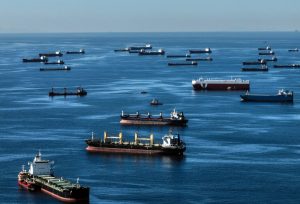
What is slowing down Ukrainian containers from Polish ports? Interview with Oksana Antipa from OFF-DOCK Gdańsk
27.11.2026 - 18:11

The Port of Gdańsk Administration estimates the share of the Baltic Hub container terminal in the Ukrainian market at approximately 40%. Oksana Antipa, Head of Sales and Logistics at OFF-DOCK Gdańsk, who has been working with Ukrainian cargo in Polish ports since 2022, believes that this share now reaches 55–60%. Together with Gdynia, according to her estimate, about 70% of Ukrainian containers pass through Polish ports.
The main delays do not occur at the terminal. Due to queues at the border, truck delivery to Ukraine has in some cases doubled in price, and some containers remain in the port because customers have nowhere to take their goods.
In an interview with USM, the expert told why Gdańsk wins over Constanta, what slows down cargo after the port, and which goods are currently most actively transported to Ukraine.
How many Ukrainian containers go through Gdansk?
— How relevant is the official estimate of the share of Baltic Hub in the Ukrainian container market — 40%?
I think that this share is even higher now. Perhaps 40% corresponded to the period when a significant part of Ukrainian cargo still went through Romania.
In June and July, the Romanian direction was calmer. But after the intensification of shelling and new problems with warehouses, Ukrainian clients began to redirect cargo from Romanian ports to Gdansk.
According to my rough estimate, 55–60% of Ukrainian container traffic can now pass through Baltic Hub and another 10–15% — through Gdynia. Some clients choose Gdynia because there are services of individual lines there, in particular Hapag-Lloyd, ONE and Yang Ming. Sometimes the lower freight rate decides. But in general, according to my observations, most Ukrainian containers still pass through Baltic Hub.
— Why Gdansk and not, say, Romanian Constanta? For which cargoes are Polish ports more profitable, and when should you choose a different route?
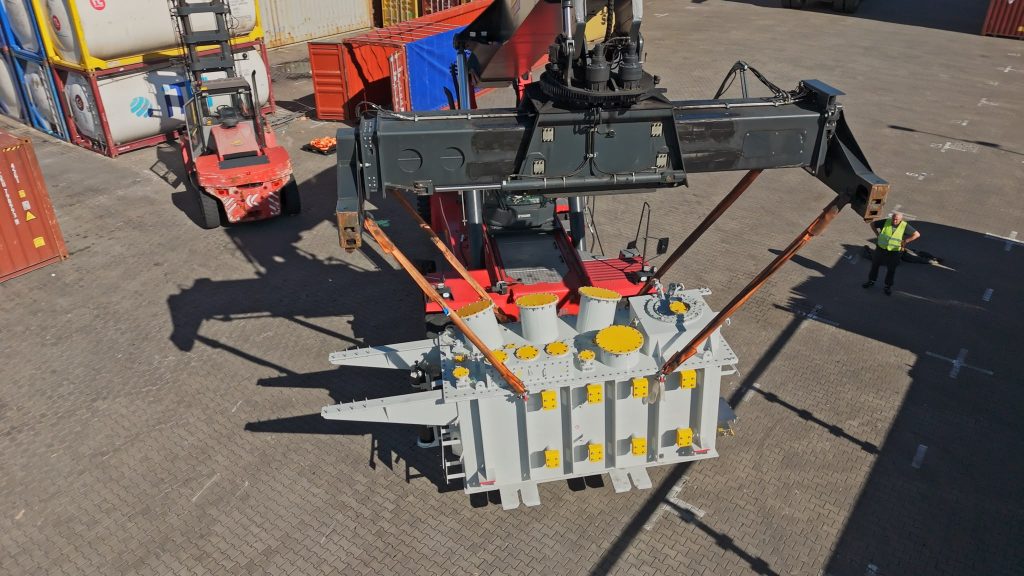
There are categories of cargo that we ourselves transport through Romania. First of all, this is very large project equipment – large-sized cranes or heavy transformers, which due to their size cannot be transported in standard containers.
But for standard container transportation and many types of oversized cargo, the Polish route is often more profitable. For certain types of cargo, the difference in freight costs in favor of Polish ports can be 1.5–3 thousand dollars.
Local port costs are also important. According to our calculations, reloading a regular container in Gdansk costs approximately 260–300 euros, in Romania – up to 550–600 euros. The processing of a T1 transit document in Gdansk usually costs 50–70 euros, in Romania it costs around 100–150 euros.
But it’s not just about the price. Predictability of timing is very important. In Gdansk, transit documents can be obtained in about one or two days. In Romania, this process sometimes takes eight to ten days.
For a freight forwarder who has to order a truck in advance, plan the transshipment and coordinate the delivery with the client, this makes a huge difference. In addition, Gdansk has a more developed road infrastructure, more warehouses and a wider choice of logistics operators.
The conditions for storing containers also vary. Baltic Hub usually gives five days free of charge. In Romanian ports, according to the conditions we encountered, there may be no free period at all – the fee is charged immediately after the container is unloaded. This is another cost item that must be taken into account when choosing a route.
Therefore, in our practice, approximately 90% of the cargo of the clients I work with passes through Polish ports. There are also problems here – for example, strikes on the Polish-Ukrainian border, which can seriously complicate transportation. But in general, the Polish logistics system is more predictable for us. We understand the rules, can estimate the terms and calculate the costs in advance. At the same time, I would not completely abandon the Romanian route. For some project and super-heavy cargo, it remains a good, and sometimes even more economically advantageous, option.
— How did it happen that Ukrainian containers are so dependent on Polish ports?
At the beginning of the war, a huge amount of Ukrainian cargo got stuck in Romanian and other European ports. Customers could not deliver the goods, and new routes were not established immediately. Communication was complicated by different approaches to work in Ukrainian, Polish and Romanian companies. All this cost significant additional costs.
At first, Ukrainian companies looked for partners in Romania, later in Poland. The problem with the Romanian route is that Constanta has less capacity: there are fewer container terminals and transshipment equipment. So when the Ukrainian flow increased, the infrastructure quickly became overloaded. In addition, local port costs in Romania are significantly higher than in Poland.
At first, the new routes were extremely expensive for customers. Gradually, companies found optimal solutions, negotiated with carriers and warehouse owners.
The key became the transshipment of goods from sea containers to road transport. At the beginning of the full-scale war, shipping lines did not allow their containers to be imported into Ukraine due to security risks. Therefore, the goods were unloaded in Poland, reloaded onto a truck, and only then transported to the customer.
A boom in warehouse logistics began. Polish companies rented and bought new warehouses, and Ukrainian forwarders opened representative offices in Poland – among them Global Ocean Link, Uni-Laman and other large companies. Subsequently, about 70% of Ukrainian container cargo went through Polish ports.
The security situation on the border with Romania also played a role. Despite the geographical proximity of the route, shelling and long queues created additional risks. There were cases of destruction of cargo, and the processing of transit documents could be delayed for ten days. Therefore, even goods for Odesa were often transported by Ukrainian companies through Polish ports or through other checkpoints, including Slovak ones.
Gdansk has a significant advantage here. Baltic Hub is a large container hub that is constantly expanding and accepts ocean-going vessels with a capacity of up to 24,000 TEU. Gdynia is located approximately 30 km away with the Baltic Container Terminal (BCT) and Gdynia Container Terminal (GCT).
Therefore, cargo flows can be distributed between several terminals depending on the services of specific lines. For example, Maersk and Hapag-Lloyd call at both Baltic Hub and Gdynia.
At the same time, each terminal has its own rules regarding documents, transshipment, and the export of heavy and oversized cargo. Sometimes this is what determines which port to choose.
— You mentioned different approaches to logistics in Ukraine, Poland and Romania. How did this affect working with Ukrainian clients?
At first it was a real culture shock. I worked in large Polish companies and at the same time constantly communicated with Ukrainian partners from Odesa, Kyiv and other cities. The difference in approaches to customer service was very noticeable.
In Ukrainian logistics, we are used to being in touch almost 24 hours a day, seven days a week. If an urgent issue arises, it is resolved, regardless of whether it is an evening or a day off.
In Poland, it is different. If an employee has a working day from 8:00 to 16:00, the employer cannot require him to work after the shift, unless this is provided for in the employment conditions.
I have repeatedly seen a Ukrainian client urgently waiting for documents – let’s say, customs sent them at 17:00, and the Polish employee has already finished the work. For a Ukrainian freight forwarder, this meant the risk of truck downtime and additional costs.
Polish companies were not immediately ready to change. But Ukrainian clients simply went to those who could work more flexibly. Eventually, the Polish market saw what volumes of cargo Ukrainian business provides and how much it gives to the local economy. Companies began to adapt and hire Ukrainian specialists who spoke their language to clients and better understood the specifics of the work.
I think that the Ukrainian cargo flow also significantly influenced the development of Polish port infrastructure. The volumes were so large that they created additional grounds for investment and expansion of terminals.
The situation is different with Romania. In my experience, it is more difficult to predict the terms of clearance there. Customs procedures are less flexible, may require translation of all documents into Romanian, and sometimes you have to wait a long time for answers. Because of such delays, it is difficult to order transport in advance and avoid downtime costs.
In Poland, however, the procedures are more formalized. If a customs inspection is scheduled, it must be passed, but the rules by which the system works are clear. This allows you to plan your delivery more accurately.
“The freight forwarder is working at a loss”
— In August, you wrote that Europe does not need larger ports so much as ports that can quickly send cargo further by land. How has the situation with the processing of Ukrainian cargo in Gdansk changed since then?
It has gotten a little better recently, but primarily due to the reduction in cargo traffic. In September and October, the volumes were smaller than last year in the same months.
In my opinion, this is to some extent deferred demand. Many warehouses and retail facilities have been destroyed due to Russian shelling in Ukraine. Some companies, including large retail chains, have temporarily reduced orders because there is simply nowhere to transport new batches.
There is another category of customers – companies that import raw materials, such as polyethylene or polyethylene terephthalate in granules. Some of such cargo is stored in our warehouses in Poland until buyers are ready to pick them up.
The demand for these materials has not disappeared. But companies need time to find new warehouse space, review logistics, estimate costs, and attract financing. This also affected volumes in September and October.
Another factor is the Ukrainian-Polish border. Due to security threats, during air raids, truck clearance at certain checkpoints is suspended. As a result, vehicles are waiting in queues for longer, and the number of available vehicles on the market is actually decreasing. A route that previously took a carrier three days now sometimes takes ten.
All this time, the driver must be paid and other expenses must be covered, so trucking rates have increased sharply. According to our examples, the delivery of one truck, which previously cost about 3.5–4 thousand euros, has in some cases risen to 7–8 thousand.
This is a serious problem for Ukrainian freight forwarders. Often, they sell the client a full service — sea freight and door-to-door delivery in Ukraine — even before the ship leaves the port of departure.
Initially, the price is fixed in the contract, and when the cargo arrives in Europe, road delivery can cost almost twice as much due to queues and a shortage of transport. The forwarder still has to fulfill the order, so he works at a loss.
The market is also affected by payment delays from the Ukrainian side. Among the clients of the companies we work with are large industrial enterprises. As far as I know, in some cases, significant debts arise due to financing delays. This, of course, affects the working capital of forwarders and how many new orders they can take.
So some cargoes do get delayed in the port. But not always due to a lack of terminal capacity. Sometimes the client simply has nowhere to deliver the goods, and sometimes he cannot find transport at an acceptable price.
— In your post, you drew attention to containers that remain at the terminal after being unloaded from the ship and cannot move on in time. How much time does it take on average from the ship’s unloading to the container’s removal from the Baltic Hub, if the cargo is going to Ukraine?
A lot depends on the client himself: is he ready to accept the cargo, does he have the necessary documents, and where exactly does he plan to transport it?
For example, we have clients who import pipes and blanks for their production. Some large batches have been lying in the port for a long time because the customers could not immediately deliver them to enterprises or warehouses.
That is, the delay was not due to Polish roads or the lack of terminal capacity, but because there was nowhere to store the goods.
As for our operations, under favorable conditions, we can pick up a container from the Baltic Hub approximately two days after unloading from the ship. On some days, our company exports up to a hundred containers.
Even before the vessel arrives, we prepare documents, receive information from the line and pay local fees. When the vessel registers in the port system, a confirmation appears and the customs broker can submit documents for transit under the T1 procedure.
Under normal conditions, the clearance takes one to two days after the container is unloaded. However, for this, the client must provide a power of attorney, invoice, packing list and other documents in advance.
All payments must also be paid, and the line must give permission to release the container. If, for example, the client has not paid the freight to his agent, we will not receive the container even if there is transport available.
At Baltic Hub, the port usually provides five days of free storage, and shipping lines – an average of seven to nine days without charges for using the container, depending on the conditions of transportation. We usually agree to these terms.
We have a large portfolio of Ukrainian clients, so we plan the export in advance: how many containers to pick up daily and at which warehouse to unload them. After reloading, empty containers are returned to the depot designated by the line. Road delivery to Ukraine is organized by the clients themselves.
— That is, the main delays occur not at the terminal, but at the subsequent stages of delivery? Is the situation different in Gdansk and Gdynia?
For Baltic Hub, this is mostly the case. If the documents are ready, payments have been made, and the client has somewhere to transport the cargo, the container can be picked up quite quickly. In Gdynia, it is more difficult, especially with oversized and heavy cargo.
One of the main problems is the road infrastructure, in particular, the Kwiatkowski overpass, which connects the port with the main routes. This is an old structure that is constantly being repaired. In order to transport heavy cargo over it, special permits are required, and sometimes a separate examination of the possibility of passage.
For example, large BESS energy storage systems are now being actively imported into Ukraine. One 20-foot container with such equipment can weigh about 43 tons. To transport it from Gdynia, you need not only to find transport, but also to obtain a permit for transportation and conduct an examination of the passage over the overpass. It can cost around 1200 euros. This is a significant additional cost for the transportation economy.
Recently, colleagues from Odesa asked us to take out six such containers with batteries. I explained to them what documents are needed and how much the expertise will cost. In addition, such transport often requires the escort of special vehicles that monitor traffic safety.
In the future, the situation should be improved by the construction of the “Red Road” (ed. note: Droga Czerwona). It will provide better access to the port of Gdynia for heavy and oversized transport.
But this is a complex infrastructure project that requires time and approvals. I assume that it will take at least two to three years, although I cannot give an exact time frame.
Another problem is the lack of specialized carriers. Large battery systems are classified as dangerous goods, so they require appropriate equipment and compliance with ADR rules. In addition, they are very heavy.
In Ukraine, there are few companies capable of transporting such cargo, and their transport is sometimes scheduled almost two months in advance. If a forwarder receives an urgent order, it is very difficult to find a truck with the necessary permits and carrying capacity.
In addition, Ukrainian carriers in Poland have separate requirements for registration of transportation and route control. Violations can result in significant fines – sometimes up to 3 thousand euros.
Therefore, transportation must be carefully planned: obtain permits, determine the route, agree on the time of export and check all documents.
At the same time, Ukrainian carriers are actively adapting. Some even open Polish legal entities and register transport in Poland in order to have more opportunities on the European market.
What is being transported to Ukraine and what will speed up delivery?
— What categories of Ukrainian cargo are currently growing the fastest? And are there any whose volumes are decreasing?
First of all, I see a constant increase in the import of special equipment — excavators, cranes, fire engines, trucks. Ukraine needs them for clearing rubble, building and restoring infrastructure.
Imports of energy equipment are also growing very rapidly: BESS energy storage systems, transformers, solar panels.
We are not talking about household charging stations, but about industrial equipment. For example, an enterprise can purchase a 5–10 MW storage system and be less dependent on centralized power supply.
The war showed how vulnerable centralized energy infrastructure can be. Therefore, Ukrainian enterprises are creating their own power sources and backup capacities.
I see a similar trend in other European countries. At ReBuild Ukraine in Warsaw, we talked a lot with Ukrainian and foreign partners — Polish and Romanian companies are also actively interested in storage systems and solar panels.
I think this trend will continue to grow. A significant part of such equipment and components comes from outside Europe, in particular from China, so the demand for international logistics will remain.
In addition, we transport a lot of industrial raw materials: plastic in granules, stainless steel in rolls and sheets, fertilizers and other materials for production and agriculture.
A significant flow is components for wind power plants. Ukraine also receives a lot of Chinese cars, humanitarian aid and medical goods – gloves, syringes, etc.
At the same time, there are fewer consumer goods in our segment. I think this is due to changes in the warehouse logistics of large Ukrainian retailers.
For example, I spoke with representatives of the Aurora chain. Due to the risk of destruction of warehouses in Ukraine, companies are looking for partners closer to the Ukrainian-Polish border in order to quickly deliver goods to Ukraine in small batches. That is, such goods continue to be imported, but through other warehouses and regions, and not through our facilities in Gdansk.
Instead, grain is currently the main export. We also see significant volumes of sunflower oil and fruit juice concentrates.
Ukrainian partners are constantly looking for warehouses with equipment for grain transshipment. It comes from Ukraine by rail, in specialized wagons or containers. In Poland, it is already transshipped into standard sea containers for further export.
— You specifically emphasized the importance of off-dock infrastructure. How does this model work and how does it differ from a regular warehouse or container depot?
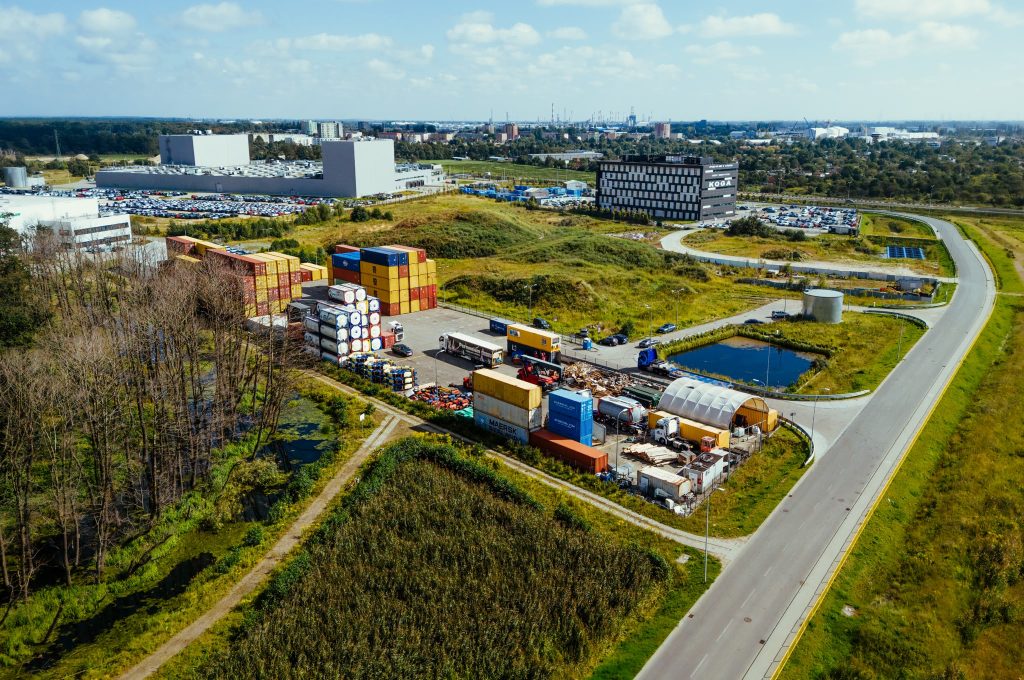
The main thing in this model is the location and the ability to perform various operations with cargo outside the port terminal. OFF-DOCK Gdańsk is located about a kilometer from the Baltic Hub. This allows us to very quickly pick up containers from the terminal and transport them to our sites.
It is especially important that we have a special permit for transportation via the internal port road. Thanks to this, we can transport heavy and oversized cargo to our warehouse quickly and without unnecessary formalities.
Other companies have to contact road services for such transportation. The permit takes about three days to issue and costs about 400 euros. If you make a mistake in the documents — you incorrectly indicate the width or height of the cargo — you have to issue the permit again, pay again and wait.
We transport a container from the Baltic Hub to our site in about 10–15 minutes. This significantly simplifies work with heavy and non-standard cargo.
Initially, the company owners planned to use the site mainly for storing empty containers. But later they saw a great demand for the transshipment of project and oversized cargo.
One of the owners, Dominik Landa, worked for many years at the Port of Gdańsk and Baltic Hub, in particular in management positions. Another co-owner, Mateusz Lukaszewski, had experience in road transport of dangerous goods. Thanks to this, the company was able to develop a separate project cargo direction.
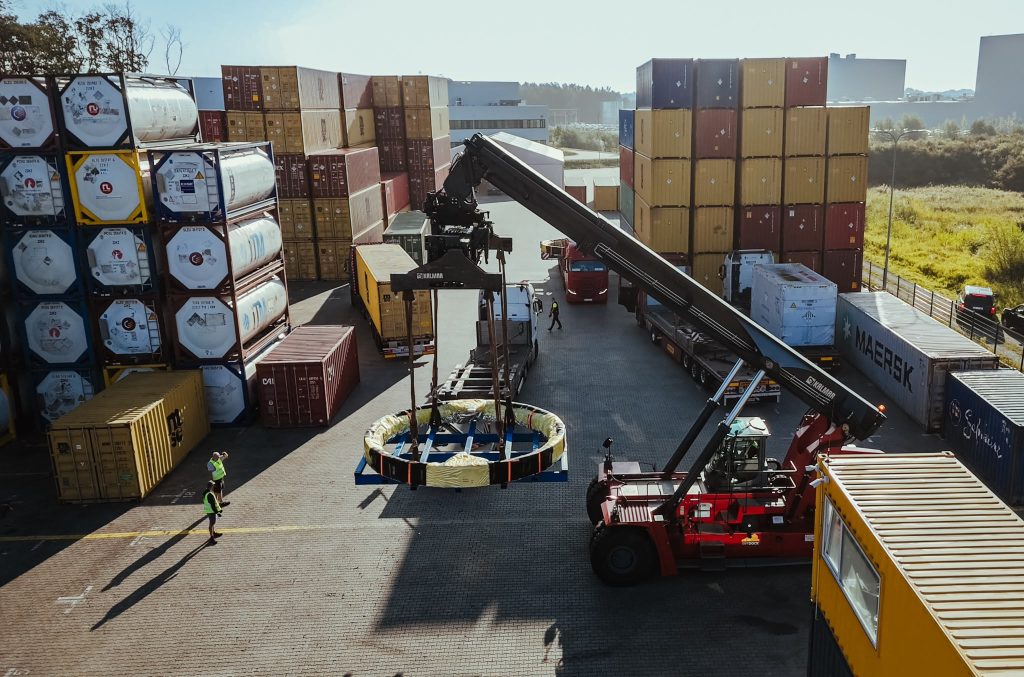
We work with large industrial cargo for Ukrainian enterprises: transformers, excavators, cranes, fire engines, metal structures, factory equipment, special tires for large quarry equipment.
Such operations require appropriate equipment. We have two heavy Kalmar container handlers, each working with cargo up to 50 tons. If the cargo is even heavier, they can be used in tandem.
In addition to the open area, there is a covered warehouse with an area of about 8 thousand sq. m. with ten ramps. There we work with ordinary goods – tires, boxes, dishes, household products and other goods, which are reloaded manually or using warehouse equipment.
Another major direction is cars. This year, about 95 thousand units of passenger vehicles passed through our facilities. According to my estimates, about 15% of them were intended for the Ukrainian market, the rest – mainly for Poland and the Czech Republic.
For this, we created a separate infrastructure: storage areas, six warehouse areas with a total area of about 30 hectares, as well as a pre-sales preparation center. There, cars are checked, washed, prepared for transfer to dealers, reports are drawn up on their technical condition and possible damage. For Chinese cars, they can also set the necessary language localization.
Our own infrastructure gives another important advantage – the ability to influence the price. It is more difficult for a freight forwarder who works only as an intermediary and does not have its own warehouses, transport or equipment to compete. It largely depends on the tariffs of contractors.
On the other hand, a company with its own capacities can more flexibly form the cost of services: offer special conditions for a large project or a discount for a regular client.
This is also beneficial for our Ukrainian partners. If we offer them a lower transshipment price, they can offer a more competitive price to their customers. Thus, off-dock infrastructure helps reduce logistics costs and speed up the movement of goods.
— What changes in the next year or two would most accelerate the movement of containers between Gdansk and Ukraine? What should the Ukrainian side do, and what should the Polish side do?
First of all, it is necessary to simplify border crossings. Currently, transportation is affected by long queues, additional control procedures, requirements for tracking transport and paperwork. All this increases the time that a truck spends on the road or waiting.
If the Polish side provided a more flexible approach to individual procedures and managed to reduce queues, transport would turn around faster. Then there would be more available vehicles on the market, carriers’ costs would decrease, and ultimately the cost of delivery would decrease. That is, for Poland, I would primarily highlight the simplification of border procedures and the acceleration of truck passage.
Today, Polish infrastructure is developing: Baltic Hub is expanding its capacity, new terminals are appearing, investments are being made in warehouses and equipment. At the same time, problems with land approaches to individual ports remain. A good example is Gdynia, where heavy and oversized cargo still faces restrictions due to the state of the road infrastructure.
A new road to the port could significantly improve the situation. But such projects require time, funding and approvals between various authorities. In general, the Polish logistics market is adapting to new volumes and needs. However, it is important to develop not only the ports themselves, but also the entire infrastructure around them.
As for Ukraine, in my opinion, our logistics companies are already working at the limit of their capabilities. I constantly communicate with forwarders from Odessa, Kyiv, Kharkiv and Dnipro and see how much effort it costs them to maintain their work in the current conditions.
But there is one problem that is really important to solve – timely financing and payment for work performed.
Some Ukrainian companies work with large enterprises and government orders. When financing is delayed, this affects all participants in the logistics chain. Forwarders and subcontractors have to pay for their staff, for transport, warehouses and terminals. They cannot operate without revenue.
More stable financing and timely payments to contractors would help Ukrainian companies maintain working capital and specialists and better plan their work.
I sincerely admire the way Ukrainian partners continue to work. Sometimes I ask my colleagues how they manage to withstand such a load.
They answer that they used to have three regular work tasks in the morning, and now they have five or six more unforeseen problems that need to be urgently resolved.
But they continue to work because this is their home and their business. And I really want them to have the opportunity not only to survive, but also to develop normally.