Agrologistics of Ukraine in 2025: life in the “new normal”
9.01.2026 - 12:00
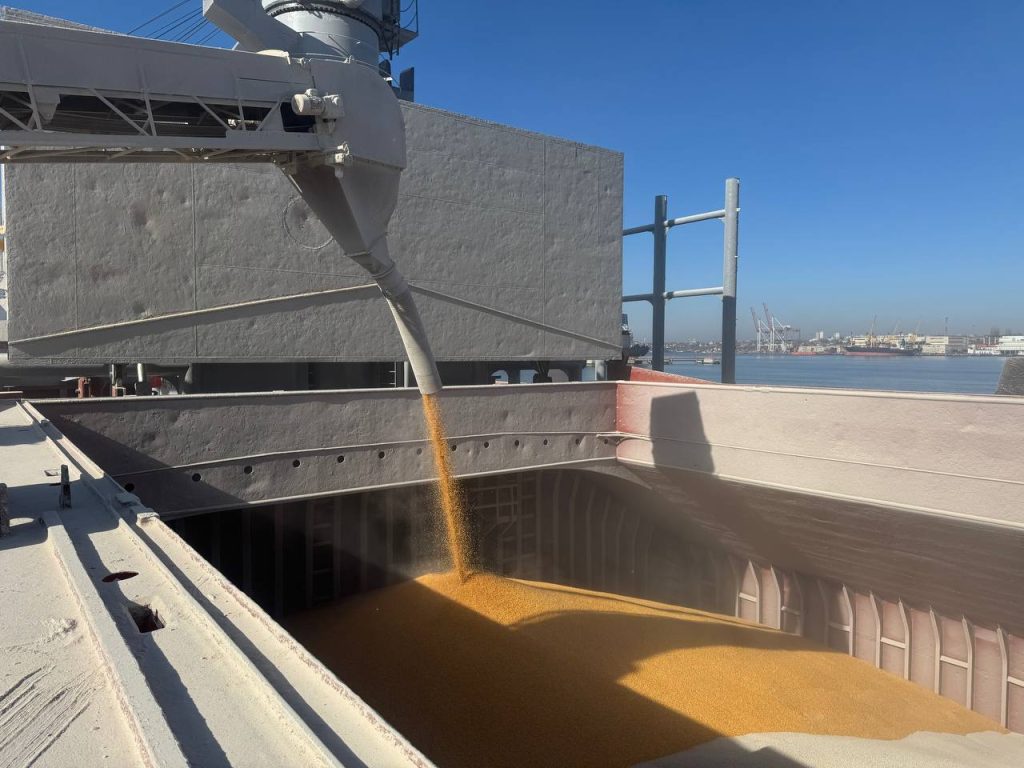
Exports of grain and leguminous crops remain critically important for the Ukrainian economy. At the same time, it should be clearly stated: pre-war conditions no longer exist — and we should not expect them to return anytime soon.
Ukrainian agrologistics operates in a fundamentally new reality, where key factors are war risks, infrastructure instability, constant change of routes, and rising logistics costs.
Dmytro Kazanin, owner and director of the transport and logistics company TEUS, tells USM how the market is adapting to this “new normal.”
Key figures of the year
According to preliminary results for 10–11 months of 2025, exports of grain and leguminous crops remain lower than last season, despite the intensification of supplies in the second half of the year.
The market has not yet reached pre-war volumes, and the key restraining factors remain war risks, infrastructure restrictions, and increased logistics costs.
According to market participants, by the end of the year, the total volume of grain group exports will be 20–25% lower than in the previous season.
At the same time, the structure of cargo traffic has changed significantly: the role of alternative routes and container shipments has increased, while classic bulk schemes operate with increased load and risks.
In parallel, in 2025, Ukrainian ports continued to demonstrate growth in container transportation, including in the agricultural segment.
According to the results of 10–11 months of 2025, container turnover in Ukrainian ports remains at the highest level for the entire period of the full-scale war, exceeding the indicators of the previous year.
According to market participants, the share of agricultural cargo in containers is steadily growing, primarily due to niche crops, processed products and small batches, for which containerization allows for better management of risks, terms and financial obligations.
It is important that this dynamics persists despite the increased shelling of container and port infrastructure in the second half of the year. This indicates that container logistics in the agricultural sector is gradually moving from a temporary solution to a structural element of the export model, ensuring flexibility and diversification of supply channels.
In a number of cases, the container model allows not to minimize costs, but to ensure predictability of contract execution – which in war conditions becomes a key competitive advantage.
The Danube: from a backup route to an element of logistical resilience
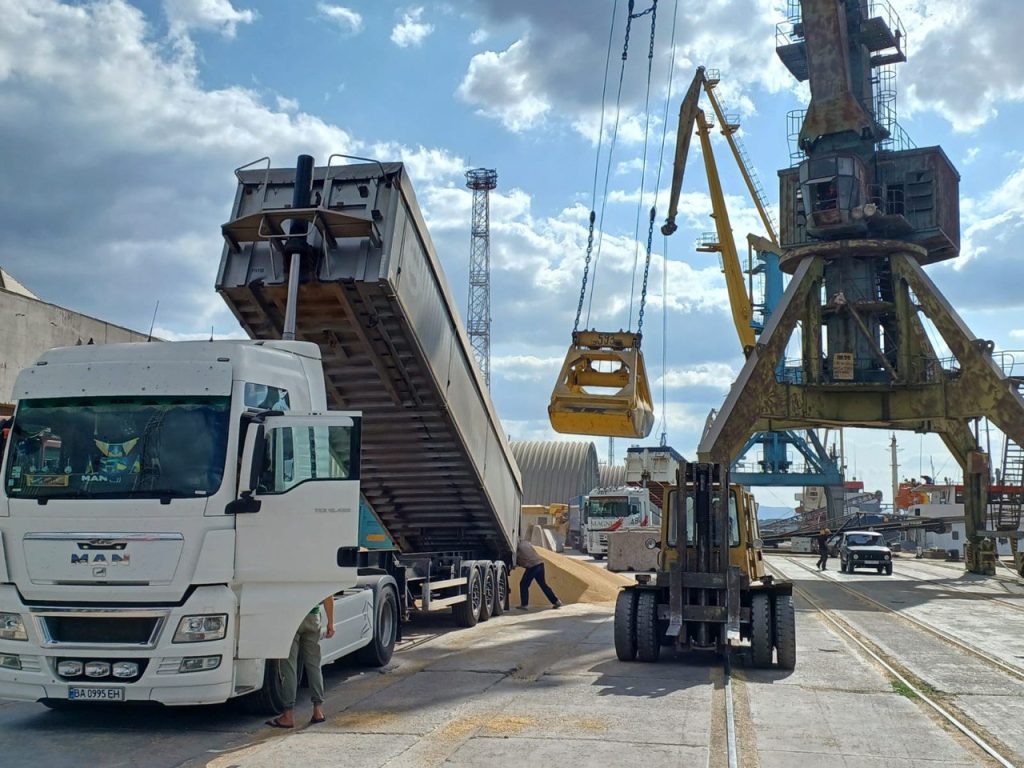
The Danube direction deserves special attention in 2025, the role of which is gradually being rethought by both business and the state.
After the peak load in 2022–2023, when the ports of Izmail and Reni actually became the only alternative to the blocked ports of Great Odesa, their importance temporarily decreased against the backdrop of the resumption of sea exports.
At the same time, the events of 2025 showed: the Danube cannot be considered exclusively as a temporary solution.
The conditions of constant shelling of port and railway infrastructure, insurance risks and instability of sea corridors force the market to keep the Danube cluster in working order – as an important element of route diversification.
This approach is also reflected in state policy.
The plans presented by the Ministry for Development Communities and Territories envisage the integration of the ports of Reni, Izmail and Kiliya into a single administrative and logistical space, which for the first time forms a vision of the Danube as a strategic element of national logistical security, and not just a “backup route”.
If systematically implemented, such a model can:
- reduce the fragmentation of port management;
- optimize port dues and eliminate internal competition;
- ensure a more balanced distribution of cargo flows;
- create the prerequisites for attracting investments in critical infrastructure.
However, from a business point of view, administrative solutions are not enough. Without the modernization of access roads, railway infrastructure and storage areas, the throughput capacity of the Danube region will remain limited. It is these factors that will determine whether the Danube cluster will be able to function stably in the long term – even after the full restoration of the ports of Great Odesa.
From TEUS’s perspective, the Danube today is a critically important “insurance route” that reduces the concentration of risks in maritime logistics. Its development is not a matter of competition with the ports of Great Odesa, but part of the strategy for the national sustainability of Ukraine’s logistics chains in conditions of war and high uncertainty.
Infrastructure risks as a new reality of agrologistics
One of the main problems of the year is the systematic shelling of port and railway infrastructure. Over the past three months, a number of attacks have occurred on the ports of Odesa, as a result of which civilian vessels and personnel were injured. This directly affected:
• a sharp increase in insurance rates;
• an increase in the cost of logistics;
• an increase in operational risks for cargo owners.
Logistics in Ukraine has ceased to be just a matter of efficiency – it has become a matter of risk management and survival of marginality.
Read also: A year in the ports of Great Odesa: what challenges did the industry overcome in 2025
Railway logistics market: a zone of turbulence
The end of 2025 confirmed: the railway logistics market remains one of the most vulnerable elements of agricultural exports. Constant external and internal disruptions have turned grain transportation by rail into a factor of increased risk – both in terms of terms and cost.
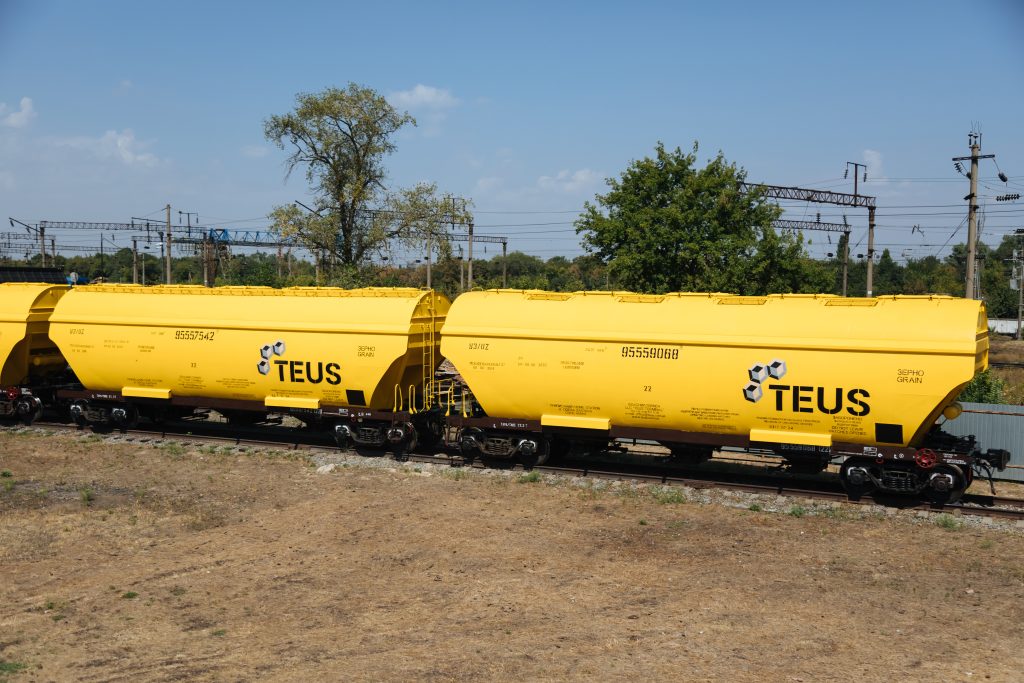
In the second half of the year, the rental rate for grain wagons increased to 3,000–3,500 UAH/day (excluding VAT) – this is the highest level in recent years. At the same time, the increase in rates is a consequence, not a cause, of deep structural problems in the market.
The combination of factors that have shaped the current situation is systemic:
• regular shelling of railway infrastructure in the southern regions;
• reduction in the throughput capacity of key stations;
• drop in wagon turnover to 1.6–1.7 turnovers per month;
• actual loss of 4–5 working days each month due to air raids;
• shortage of vehicles and drivers, which increases the load on the railway;
• reduction of the working fleet of grain trucks to 24–25 thousand units compared to about 32 thousand in previous years;
• seasonal peak in corn exports, which overlapped all the above restrictions.
As a result, the physical throughput of the market is currently estimated at 2.2–2.6 million tons per month, while the real need during peak periods reaches about 4 million tons.
This gap creates a chronic shortage of resources, which is directly reflected in the cost of logistics.
Freight market: end of the year without sharp movements
In November – early December 2025, the freight market was in a state of cautious balance and expectation.
Limited exports of early grain crops – primarily wheat and barley – restrained the activity of the bulker fleet, while the key expectations of shipowners were related to corn exports in the fourth quarter.
In fact, the market worked in the mode of compensation for seasonal imbalances: shipowners tried to cover weak indicators for early crops at the expense of corn, while charterers acted as cautiously as possible, taking into account the general instability of logistics and military risks.
The forecast for the end of the year and the beginning of 2026 remains restrained.
In the absence of new geopolitical or security shocks, freight rates are likely to remain near current levels, without sharp fluctuations, and the market will continue to operate in a mode of short transactions and high sensitivity to any changes in cargo flows.
The “new normal” of agrologistics
The events of 2025 confirmed that the changes are not temporary, but structural in nature. Among the key features of the new reality:
• smaller and more fragmented cargo volumes;
• constant diversification of routes;
• the growing role of integrated logistics;
• increasing logistics costs;
• constant infrastructure risks;
• the need for scenario-based, rather than linear planning.
At the same time, it is these challenges that stimulate the development of alternative routes, digitalization, deeper integration of logistics chains, and professional risk management.
“Today, effective logistics is not about the shortest route. It is about the ability to work in instability, quickly restructure, and fulfill obligations even in the most difficult conditions,” notes Dmitry Kazanin.
Read also: Soybean amendments, the Chornomorsk concession, and the appointment: the most important government decisions of 2025
Year in review
2025 has finally established a new paradigm for Ukrainian agrologistics. The market has moved from attempts to “return to the way it was” to conscious work in conditions of constant uncertainty.
In this reality, the winners are not those who are looking for ideal conditions, but those who are able to build sustainable, flexible and integrated logistics solutions – taking into account risks, and not in spite of them.
Dmytro Kazanin, owner and director of the transport and logistics company TEUS