Russian grain transshipment in Kuban has halved
22.10.2026 - 13:09
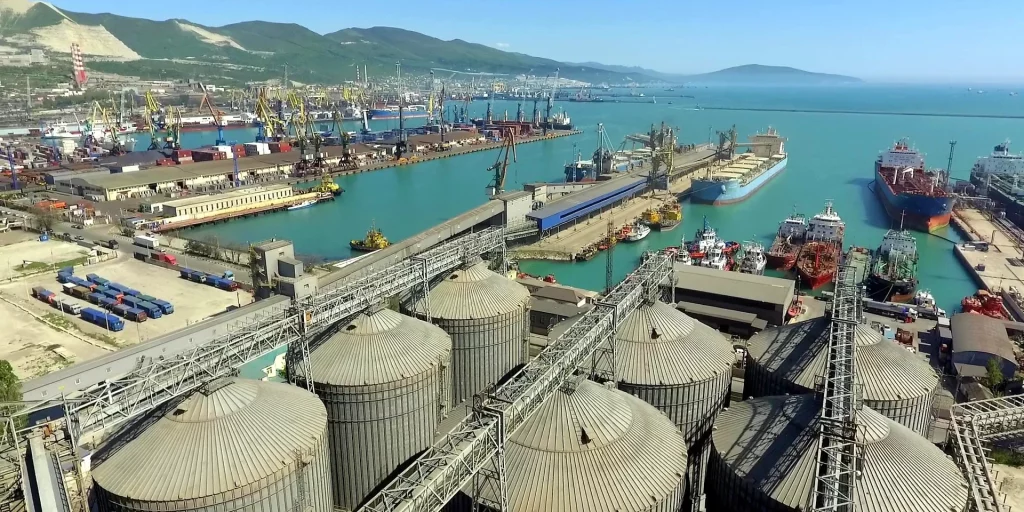
Due to drone attacks, Russian ports in the region handled only 3.8 million tons in July-August, compared to 7.9 million last year.
The work of Russia’s main seaports in the Krasnodar Territory has practically stopped due to strikes by Ukrainian drones. This was written by the governor of the region, Veniamin Kondratyev, in an appeal to the Deputy Prime Minister of the Russian Federation, Dmitry Patrushev.
Thus, in July-August, only 3.8 million tons of agricultural cargo were shipped through the region’s ports, compared to 7.9 million tons for the same period last year.
Kondratyev is asking for state funds to be allocated to the ports to compensate for losses, pay salaries, pay for rent and maintenance of warehouses, and also subsidize interest on loans. He proposes to apply the mechanism by analogy with closed airports – that is, according to the scheme that Russia uses for air hubs that are not operating due to the war. There is no specific amount in the appeal.
OTEKO, which manages the terminals in Taman, said that a month of downtime costs the Kremlin and private business 200 billion rubles. On October 6, Patrushev instructed the relevant departments to consider the proposals.
The regional authorities have already resorted to emergency measures. For example, on September 23, Kondratyev signed an order on a state of emergency, and the situation was recognized as an emergency retroactively – from August 12. Earlier, a similar regime was introduced by the Rostov region. The documents directly mention attacks on logistics infrastructure facilities, the shutdown of ports and disruption of shipping in the Azov-Black Sea basin.
The consequences go beyond the ports themselves. Up to 20 million tons of new grain harvest have been frozen in Russia – about a sixth of what was harvested by mid-September. The surplus has collapsed domestic prices for agricultural products. In the south of the country, a ton costs 4,000–5,000 rubles, half the price of a few months ago. Farmers are forced to sell their crops at a loss.
For the Kremlin, this is a loss of a significant source of foreign exchange. Grain exports brought Russia about $15 billion annually, and a significant part of it went through the Black Sea and Azov ports. From September 10 to 20, Russia exported 347,000 tons of wheat — almost a quarter less than last year.
Meanwhile, Moscow is trying to redirect flows to the Baltic and Arctic routes, in particular, through Ust-Luga and Murmansk, but the capacity of these routes is limited, and logistics are much more expensive.