A yachting project with Ukrainian roots. Kyrylo Soliar — about Boatscribe, which was the first to integrate yacht rental into Google Maps
11.05.2026 - 18:00

The Boatscribe platform aggregates yacht rental offers around the world and integrates them into Google Maps. The solution is designed to solve one of the main problems of the market – finding new customers in conditions of stagnant demand.
USM spoke with the founder and CEO of Solar Digital, co-founder of the Boatscribe project, Kirill Soliar, about the goal of Boatscribe, the state of the industry in the world and in Ukraine, AI in the market and how digital solutions are changing yachting right now.
— Tell us a little about yourself and the Boatscribe project. How did it come about?
My name is Kyrylo Solar, I am the founder and head of the IT company Solar Digital. We develop individual brands, design and create web and mobile applications of varying levels of complexity, but we mainly focus on complex projects. Our main specialization is solutions for travelers and logistics, in particular maritime logistics.
We already had experience in this area, the Sailica project, which we developed together with Stark Shipping. It was a service for international yacht booking. And based on it in 2022, together with our partners, we launched a new project, Boatscribe.
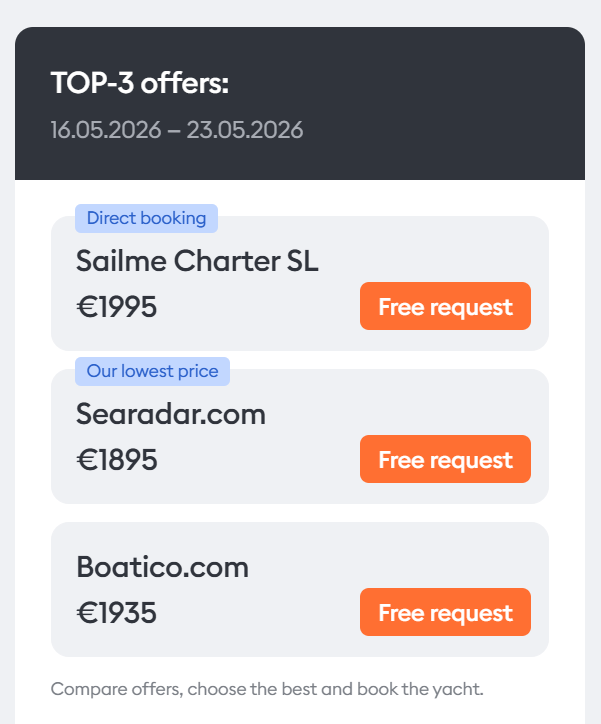
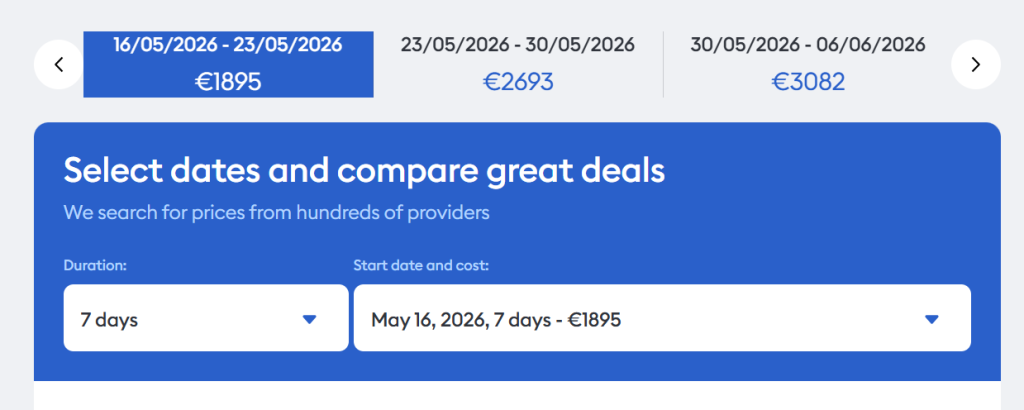
Its idea is that we aggregate data about yachts available for rent around the world. And not only the yachts themselves, but also offers from various sellers, agents and charter companies. That is, we collect all price options for the same yacht for a specific period in one place.
This way, the user can not only find a yacht, but also choose the best deal. In essence, this is an online price aggregator model like Skyscanner, only for the yachting market.
We launched the product in 2023 with our own funds, received the first sales, after which we attracted the first round of investment from a private investor and a Turkish charter company. This allowed us to move on to more active scaling.
According to EU-Startups, the yacht rental search engine platform Boatscribe attracted over 250 thousand euros in pre-Seed.
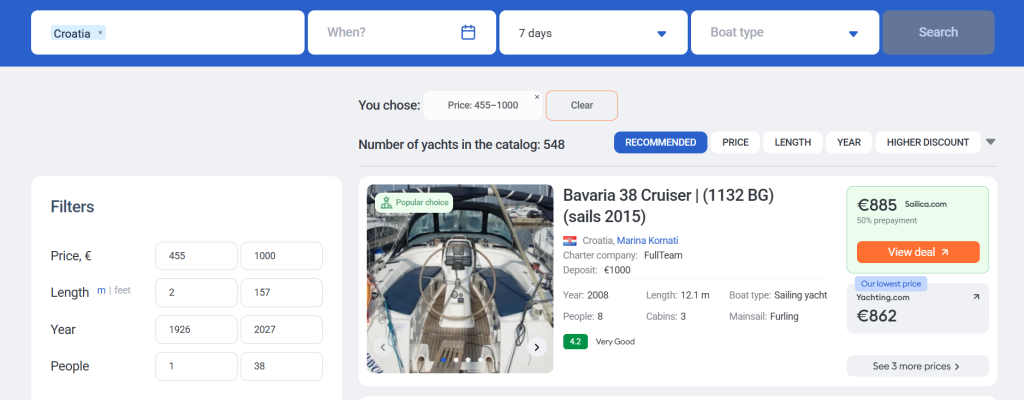
Screenshot from the Boatscribe website.
— How did your solution end up in Google Maps?
If we talk about the appearance of yachting services in Google Maps, then this is part of the general logic of Google. For example, if you open the Louvre, there is a Tickets tab there — you can immediately buy tickets. Similarly, in tourist locations, for example, in Dubai Marina — you can find offers of boat trips or other travel activities.
This works through a Google program called Google Things to Do. Within its framework, Google cooperates with companies, receives content from them and displays it as ready-made travel products directly on maps.
We joined this program, entered into a contract with Google, and thus our data began to be displayed in Google Maps. It is currently working in test mode in several locations: we are polishing the processes, checking how everything works, and will further scale this solution.
Google Things to do is a tool for searching for and booking excursions, tickets for certain events, and to certain attractions, which displays offers in Google search results and on Maps.
— What exactly did Boatscribe bring to the yacht market? What is the key difference from what already existed?
To put it bluntly, yachts had already appeared on Google Maps before, but they were in completely different formats. Mostly these were some short offers, hourly or daily trips, excursions, that is, day charters.
But the main yachting market is about something completely different. This is a full-fledged charter: when a person or a company rents a yacht for several days or even a week. This can be a bareboat charter with a captain — or without, for your own recreation.
And these were the offers that Google Maps had never had before. We were the first to bring this segment, a large and global market (especially in the Mediterranean region) directly to the maps. This is the key innovation of Boatscribe, and it has aroused quite a lot of interest in the industry. Now many charter companies themselves come to us and ask how they can join this model and get into such a partnership.
— Where exactly are you testing the product right now and what are your plans for expansion?
We are currently testing the delivery mechanism itself at several marinas. At the same time, we are actively working on expanding our geography: Ibiza in Spain, Alimos Marina in Athens, Sicily in Italy and other popular locations. Our task is to enter key points before the start of the yachting season, so that we can be present there when the main demand comes.
— How scalable is Boatscribe technology? Can it be applied globally?
In fact, it was made global right away. We aggregate the entire yacht market, which is generally available on the Internet: we automatically integrate, parse and update data.
We currently have over 36 thousand yachts on the platform, in fact, the entire charter fleet that can be found. And after a charter company signs an agreement with us, we can display its fleet on Google Maps in the desired geography.
But here is an important point — we work specifically with partners, that is, access to this tool is through cooperation with us.
— Are you considering integration with other platforms or marine systems, such as AIS?
Yes, we are already negotiating and starting cooperation with one of the leading fleet management systems, which works specifically with the charter fleet.
Closer to the summer, we plan to publicly show the results of this integration and tell in more detail how it works.
— How do you assess the current state of the yacht market?
The market is currently in a difficult state. If earlier it was growing steadily by about 5% each year, now there is stagnation and even oversaturation.
This is clearly visible in the behavior of players: charter companies are actively looking for new sales channels. The old model, when everything is given to agents and they close sales, no longer works so effectively.
Another telling point: if earlier yachts were sold out six months before the season, now many companies have them available literally a few days before the start of the rental. This is a serious shift for the industry, which is creating current problems.
The yacht charter market, which before the pandemic was growing, on average, by 5-7% per year, in the “post-COVID” period entered a phase of unstable demand. Although, according to Allied Market Research, its volume reached $11.4 billion in 2022 and could exceed $20 billion by 2032, market players are increasingly facing the problem of underutilization of the fleet and changing customer behavior.
— Do you see trends that can either push the market or, on the contrary, restrain it?
In short, the main challenge now is finding a new audience. Because the base audience on which the market was based has actually been exhausted.
We are talking about people with a skipper’s license who regularly rent yachts, several times a year, for weeks or even longer. This is a fairly narrow circle, and it is not growing. Moreover, there is no significant increase in new people in yachting schools. There is even a feeling that interest in this is gradually declining.
Therefore, now everyone is looking towards the mass tourist, but there is another problem here – a bunch of stereotypes. People think that yachting is something super expensive, complicated, not for them … or that it will make them dizzy and they simply will not be able to stand it.
And we need to work with this. In this context, entering Google Maps is also one of the tools. This is a way to show yachting to a wider audience and go beyond this professional, already “saturated” community.
— Boatscribe is more about the premium segment, can the product be useful for a smaller player as well?
On the contrary, we are trying to democratize it. Previously, only large motor yachts could appear on Google Maps, and then in the format of short excursions, somewhere in a spot, for example, in Dubai or Cyprus. We now give smaller players the opportunity to go there as well. For example, owners of yachts in the 11-15 meter segment.
That is, it works both ways: for the user it is a chance to find more affordable options, not only “luxuries”, and for business it is an opportunity to be present on Google Maps regardless of the size of the fleet.
Screenshot from the Boatscribe website.
— What is happening with the yacht market in Ukraine now?
In fact, it has stopped. Due to the war, yachting within the country is almost non-existent.
For example, in Odessa the sea is closed, yachts are standing on the shore. Part of the fleet is being exported abroad or sold. There is some activity on the Kiev Sea, but it is more of a sports format and very spotty. This cannot be compared to what it was before the full-scale invasion.
Demand from Ukrainians for yacht rentals abroad has also fallen. It exists, but is much smaller and episodic.
— What are Boatscribe’s plans for scaling the product?
We are currently actively signing contracts with charter companies and will expand their presence on Google Maps.
To do this, we plan to launch personal accounts for partners through which they will be able to manage their fleet and presence. In parallel, we are already testing AI chatbots that will help users choose yachts, suggest which option is best, and which routes are worth considering.
We also plan to launch mobile applications in the App Store and Google Play in the coming months. And another direction is a rating system: for charter companies, yacht models, and locations. The idea is to make the choice as clear and transparent as possible, so that the user is guided not only by price, but also by quality.