The suspension of ship calls almost paralyzed agricultural logistics to Ukrainian ports
27.07.2026 - 13:57

Road and rail routes cannot yet compensate for the loss of the sea channel.
At the end of last week, Ukrainian agricultural exports slowed down sharply due to the virtual halt of sea shipments. This is stated in the Spike Brokers report.
The main reason was the lack of shipping safety guarantees. Most shipowners are not ready to send their fleet to Ukrainian ports.
Due to uncertainty, exporters have almost stopped sending cargo to ports by road and rail. Companies do not want to accumulate grain, wagons and vehicles near terminals without understanding the arrival times of ships.
Cargo is already accumulating in ports. Exporters are postponing new shipments until the security situation improves and stable ship calls are restored.
According to Spike Brokers, as of July 23, Ukraine exported 3 million tons of agricultural products. The largest volumes fell on corn, wheat and sunflower oil. Corn exports amounted to about 1.3 million tons. 955 thousand tons of wheat were shipped, and 198 thousand tons of sunflower oil.
Wagons have stopped being sent to ports
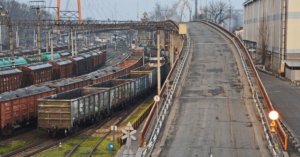
Grain truck operators have significantly reduced new shipments to sea terminals. Market participants are trying to avoid a buildup of wagons at port hubs. Rolling stock downtime creates additional costs and blocks grain truck turnover.
Transportation through western border crossings remains more stable. However, their capacity is not enough to replace sea exports.
Rail logistics to Europe are also being held back by repairs on key routes through the Czech Republic to Italy and Germany. This slows down the movement of goods and limits the ability to increase supplies.
Automotive exports have not replaced maritime logistics
From July 1 to 23, 213.4 thousand tons of agricultural products were exported by road. The largest cargo flows passed through the Polish, Romanian and Hungarian borders. The main checkpoints remained Kraków-Korczów, Porubne-Siret, Yagodyn-Dorohusk, Rava-Ruska-Hrebenne and Chop-Zahon.
Road transport mainly transported processed products and cargo with high added value. The largest volumes were sunflower oil, poultry meat, ethyl alcohol, sugar and soybean meal.
At the same time, the share of grain remained insignificant. Transportation of large batches of grain by road is more expensive and less efficient than sea delivery.
According to analysts, there was no sharp reorientation of cargo to western road crossings either. Exporters are not ready to compensate for the loss of the sea channel at any price. Most companies are taking a wait-and-see approach. The market is counting on the resumption of port operations, rather than a large-scale transition to more expensive land logistics.
Port prices have lost their real value
The almost complete cessation of trade through seaports has led to a loss of liquidity on a port basis. Thus, purchasing activity in the direction of deep-water ports is practically absent, and new deals are almost not concluded. Because of this, CPT Odesa prices increasingly reflect the real state of the market. They are mainly indicative in nature.
Over the week, the SPIKE CPT Odesa index for corn fell to $200 per ton. The price of food wheat fell to $198, feed wheat to $188 per ton. Even on the western border, trade remains restrained. The SPIKE FCA Chop index for corn fell to $228 per ton.
Buyers of the new crop on the western border are offering €205–207 per ton for delivery in November-January. However, the number of contracts remains small. On the other hand, producers are in no hurry to sell grain. They expect the resumption of sea exports and clearer price guidelines.
Part of the cargo is transferred to the Danube
The first signs of revival have appeared in the Danube ports. Exporters are gradually reorienting some of their wheat and other cargo there. However, the Danube cannot completely replace the deep-water ports of Great Odesa either.
Its capabilities are limited by the capacity of the ports, approaches and transshipment infrastructure. Additional logistics costs also reduce purchase prices for producers.
The western border and the Danube remain the main alternative routes. At the same time, they are able to accept only a part of the cargo that is usually exported by sea.
Uncertainty has spread to the oil market
The stoppage of sea shipments has hit not only grain. According to experts, processing enterprises have lost the ability to predict the costs of delivering sunflower oil, meal and other finished products. Because of this, factories have simultaneously reduced the purchase prices for raw materials.
The SPIKE CPT plant index for sunflower has decreased to $690 per ton in a week. GMO soybeans have fallen in price to $445, rapeseed to $490 per ton. Port prices for oilseeds remain mostly nominal. A premium is maintained on the western border, since this route still has higher liquidity.
As Spike Brokers note, processors are not ready to actively accumulate raw materials without understanding the future cost of exports. Even stable world prices do not compensate for the uncertainty of sea logistics.
Thus, the problem has already gone beyond the ports. The lack of ship calls stops domestic transportation, reduces purchase prices and worsens the liquidity of the entire agricultural market.
Land and Danube routes support some exports. However, without stable operation of deep-sea ports, they are unable to provide the necessary volumes and competitive delivery costs. As USM reported the day before, Ukraine called on the World Trade Organization to facilitate the restoration of shipping in the Black Sea.