Ship calls in Great Odesa have dropped almost 20 times, cargo is being reoriented to the Danube
1.10.2026 - 16:00
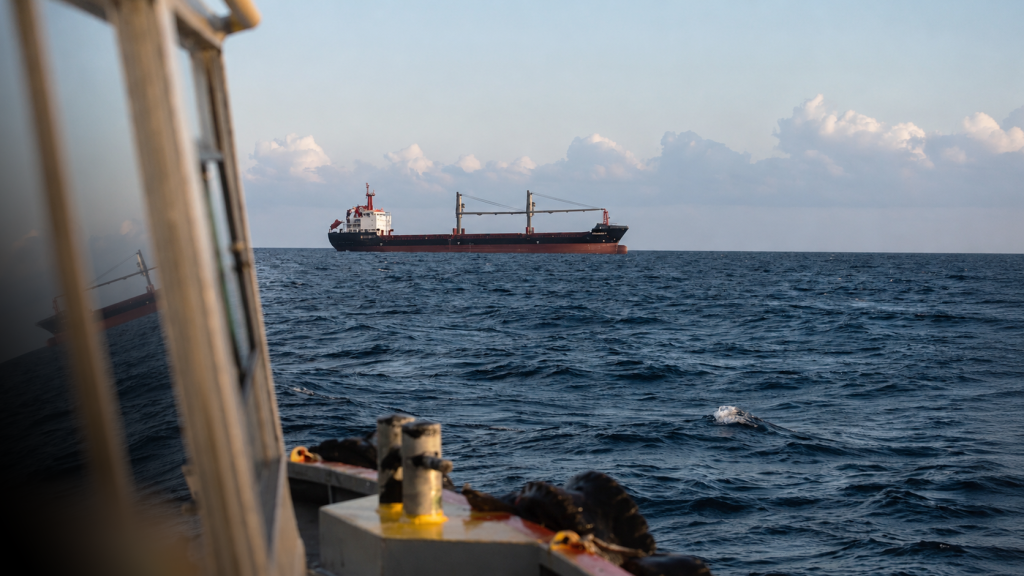
The number of ship calls to the ports of Great Odesa in 2026 decreased sharply: if in April the ports received 310 vessels, then in August – only 16.
This was reported by the President of the Association of International Forwarders of Ukraine (AMEU) Viktor Berestenko.
The number of ship calls to the ports of Great Odesa decreased from 310 in April to 16 in August 2026. Against this background, the shipping flow sharply shifted to the Danube: in August Izmail received 488 vessels, and Reni – 104.
According to Berestenko, business also began to more actively use alternative routes through Constanta, Gdansk, Gdynia and other European ports, as well as road and rail transportation.
At the same time, the first half of 2026 demonstrated the recovery of the container market. During this period, Ukrainian ports processed 124.6 thousand TEU, which is almost 30% more than a year earlier.
Each month of the first half of the year exceeded the indicators of 2025, and in March the increase was 86%. In six months, the ports have already reached about 58% of the total container turnover of 2025.
However, in July the trend changed. The total cargo turnover of Ukrainian seaports for January-August was 47.8 million tons. In April, the ports handled about 8.5 million tons, while in August – only 1.67 million tons.
At the same time, Berestenko noted that the data for Great Odesa for July-August may be incomplete. At the same time, according to his assessment, the general trend is obvious – the normal operation of deep-sea ports during this period was practically stopped.
About 82.6% of the port’s cargo turnover in eight months was accounted for by loading, that is, mainly export cargo.
Berestenko emphasized that the Danube remains a critically important alternative, but its capabilities are significantly lower than the potential of Greater Odessa.
According to AMEU, the maximum throughput capacity of Ukrainian Danube ports is estimated at approximately 1.3 million tons per month, while the ports of Greater Odessa in the first half of 2026 could handle about 6.5 million tons per month.
Among the limitations of Danube logistics, Berestenko named the draft of ships, low water levels, lack of fleet, the condition of bridges and canals, and limited throughput.
“The Danube is a very important alternative, but not a replacement for deep-sea ports,” he noted.
According to the president of AMEU, redirecting cargo through Constanta, Poland or the Baltics means additional transshipments, kilometers, wagons and cars, queues at the borders and additional costs.
Earlier, USM reported that Arkas Logistics is ceasing operations in Ukraine.