A backup route without a backup warehouse model is only half of a plan B
3.10.2026 - 15:30
USM tells how Ukrainian business is restructuring warehouse and transport logistics, why one backup route is no longer enough and how the war forces to simultaneously diversify stocks, ports and delivery methods.
Over the years of war, Ukrainian business has learned to quickly restructure logistics routes. If one direction becomes too risky, the cargo is transferred to another: via the Danube, Poland, Romania, or to another terminal and another carrier. That is, the backup route has already become a basic planning element for many companies today. But if all the goods are currently in one distribution center, this is not Plan B. These are simply several roads to one point of risk.
In 2026, this problem became especially obvious. According to the Ukrainian project to create a network of modern industrial and logistics parks WINHUB alone, out of 4.2 million sq. m. of class A and B warehouses that Ukraine had before the full-scale war, about 2.1 million sq. m. were destroyed. m. New construction in 2022–2026 added only about 800 thousand sq. m.
For example, now 68% of the pre-war warehouse stock has been lost in the Kyiv region, that is, about 1.5 million sq. m. , and in the first eight months of 2026 the region lost more warehouse space than in the previous 4 years of the war combined. And this is already affecting the economy. Businesses are looking for smaller warehouses and distributing them geographically. Demand for facilities with an area of 1.5–3 thousand sq. m. is growing, and rental rates in some offers have risen by 20–30% since the beginning of the year.
And here another problem arises: it is difficult to find ready-made space for this. According to analysts, in the first half of 2026 the vacancy rate in the Kyiv warehouse market decreased to 2.5%. In addition, this vacancy is already structural: there are almost no large vacant blocks on the market, there are mostly individual premises of approximately 1 thousand sq. m. If a business needs, for example, 10 thousand sq. m at the same time, there may simply be no ready-made facility. Over the same period, demand for warehouse rental increased by 46%, to 160 thousand sq. m., while the new supply was only 98 thousand sq. m. That is, companies are increasingly forced not to simply look for a backup point, but to assemble it from several smaller facilities or wait for the construction of a new warehouse for themselves. Analysts also note a gradual shift in demand to the western and central regions of Ukraine and expect an increase in demand for build-to-suit, distribution centers and multi-temperature warehouses.

“We see this in our clients. They are already starting to move away from the model of one large central warehouse. They are looking towards several smaller warehouses, in fact mini-warehouses in different locations. At the same time, I don’t see companies wanting to significantly increase their own inventories. The question is rather not to keep all the goods in one place, but to divide them between several points,” shares his observations Yevgeny Perez Baro, founder and CEO of Porta Maris Logistics.
Decentralization itself also requires calculation. A reserve warehouse makes sense when it can really pick up part of the operations after the loss of the main node. For one business, this may be a small safety stock of running SKUs in western Ukraine, for another – part of the goods in Poland or Romania, for a third – a separate warehouse near an alternative transport corridor. The market is already moving in this direction: the geography of warehouse activity is gradually expanding to the western and central regions. At the same time, the shortage of space means that reservations must be planned in advance: after the loss of the main warehouse, it may be physically impossible to quickly find an equivalent of 5–10 thousand sq. m today.
The reason is clear, and this is no longer a theoretical risk.
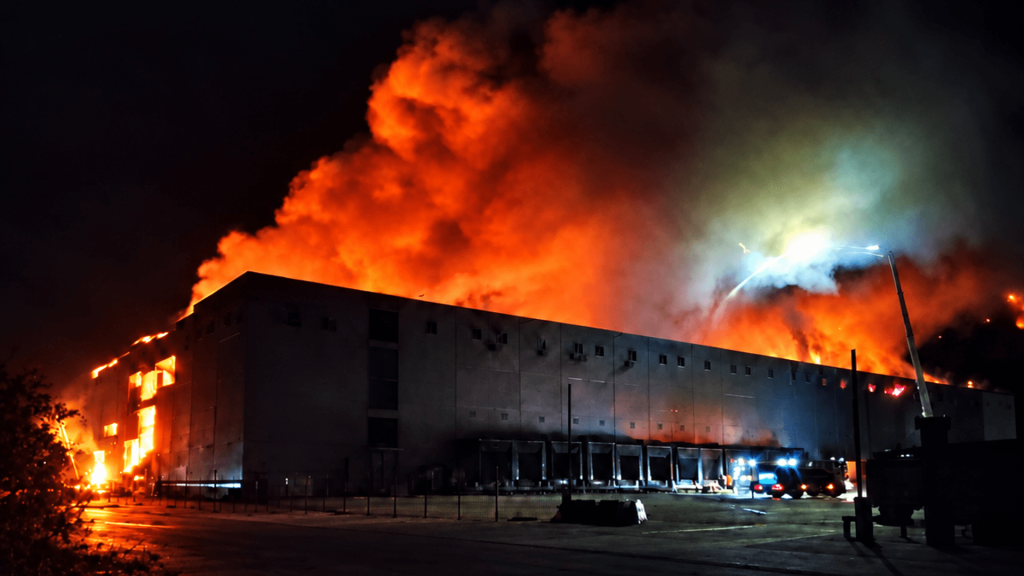
On August 18, a Russian attack destroyed the EVA distribution center in Brovary, which served all of Ukraine. The company estimated the real estate losses alone at approximately UAH 1 billion and was forced to urgently restructure its logistics. Over the 4.5 years of war, the group of companies of its co-owner has already lost 5 large warehouses.
This example shows the main mistake of the classic logistics model: a large central warehouse looks efficient as long as we calculate the cost per square meter, personnel and processing of a unit of goods, but it is worth calculating the cost of stopping the entire system, and the picture immediately changes.
In the last week alone, 16 air raids have been heard in Kyiv, lasting almost 10 hours. And the current campaign of strikes is increasingly affecting commercial facilities, warehouses and distribution centers. Therefore, today we should ask the question not about the backup route, but about the backup model for fulfilling obligations to the client.
If the main warehouse is out of service, the critical goods must already be located elsewhere. Moreover, this point should be tied to another transport route. This does not mean duplicating the entire stock. It is about something else: determining the minimum safety stock and geography that will allow the company to continue deliveries after the loss of one node.
If we talk about a full-fledged Plan B for an importer, we need to look more broadly. For example, part of the goods can be kept in small batches in warehouses in Poland and from there delivered to Ukraine in a dosed manner. That is, not to deliver the entire volume to one central warehouse at once.
“Where should such a reserve warehouse be located? I would tie it not simply to the distance from the main warehouse, but to another route. This could be a warehouse near the border, in the Lviv region or in Poland. It is important that in case of problems with the main point, you have another option for delivering goods,” notes Yevhen Perez Baro.
The same goes for transport. If earlier the company transported goods, for example, mainly by rail, today this is no longer enough. The railway can be slow, there may be delays or there may be a shortage of rolling stock. Road transport is more expensive, and there may also be a shortage of cars. Therefore, plan B is also an opportunity to combine different types of transport.
At the same time, such a model, of course, costs more. Warehouse space is becoming more expensive. For example, in Lviv, a dry warehouse of class A/B+ can already cost about 11 euros per sq. m. But now the question is not only how much the warehouse costs. We must also calculate how much the business will lose if the main warehouse stops working.
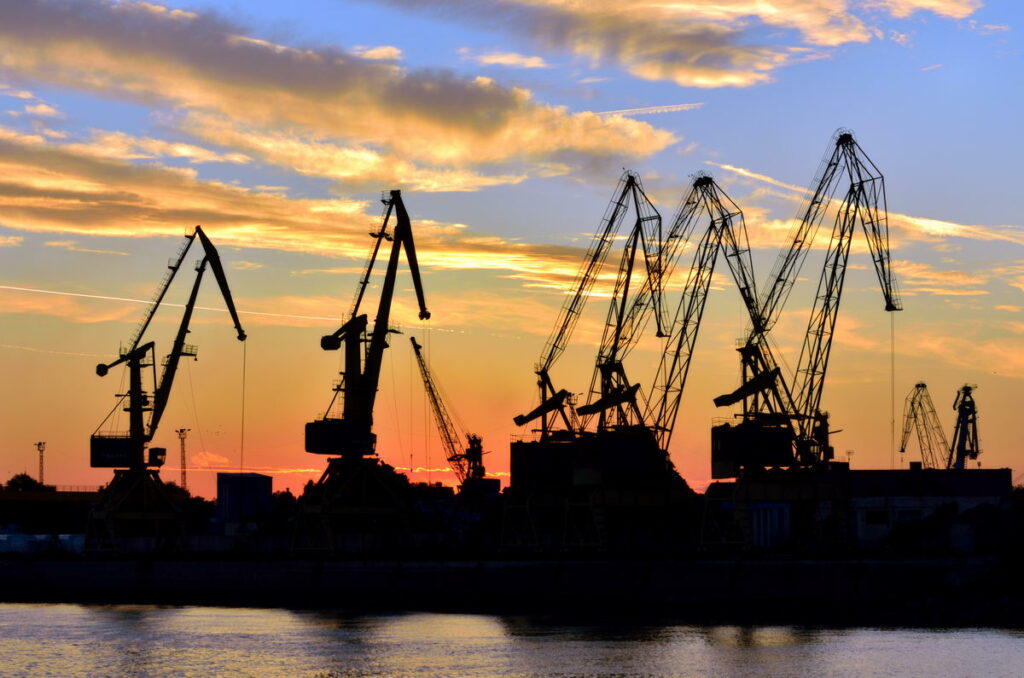
This connection between stocks and routes is especially clearly visible now in maritime logistics. After a sharp deterioration in the operation of the ports of Greater Odessa, cargo began to be transferred more actively to the Danube, railways and European ports. But each of these reserve routes has its own capacity limit. At the end of August, USM reported a queue of about 80 ships near the Sulin Canal after reorienting part of the Ukrainian cargo to the Danube. Already in September, the procedures had to be changed: ships heading to Danube ports began to be registered at the Black Sea roadstead in order to increase the number of passages through the canal during the day. That is, even a working reserve sea route can quickly turn into a new bottleneck if a significant part of the cargo flow is transferred to it at the same time. Therefore, it is better to immediately tie the warehouse reserve to a specific alternative delivery arm, rather than simply placing the goods further from the main distribution center. Therefore, in military logistics, it is not the number of reserve elements per se that is becoming more important, but whether they can work together. Two warehouses that depend on one port, one railway branch or one border crossing still leave the company vulnerable to a single failure. Similarly, an alternative port will not help much if the entire safety stock remains near the main route. The Ukrainian experience of 2026 shows this at two levels: the shortage of warehouse space forces businesses to disperse inventories, and problems with the Black Sea simultaneously disperse transport channels. It is the combination of these two things that transforms backup logistics from a set of separate solutions into a model that can survive the loss of one node. A route without a reserve does not work. A reserve without an alternative route does not work either. Resilience appears only when the entire chain is reserved, and not its individual elements. Therefore, now Plan B is not the answer to the question of where we will transport the cargo if something happens? Plan B now is a system that allows you to continue deliveries even when one of the logistics nodes is no longer there.