Old tankers, warships and how the shadow fleet threatens the Baltic. Interview with Greenpeace Ukraine Director Natalia Gozak
7.07.2026 - 14:00
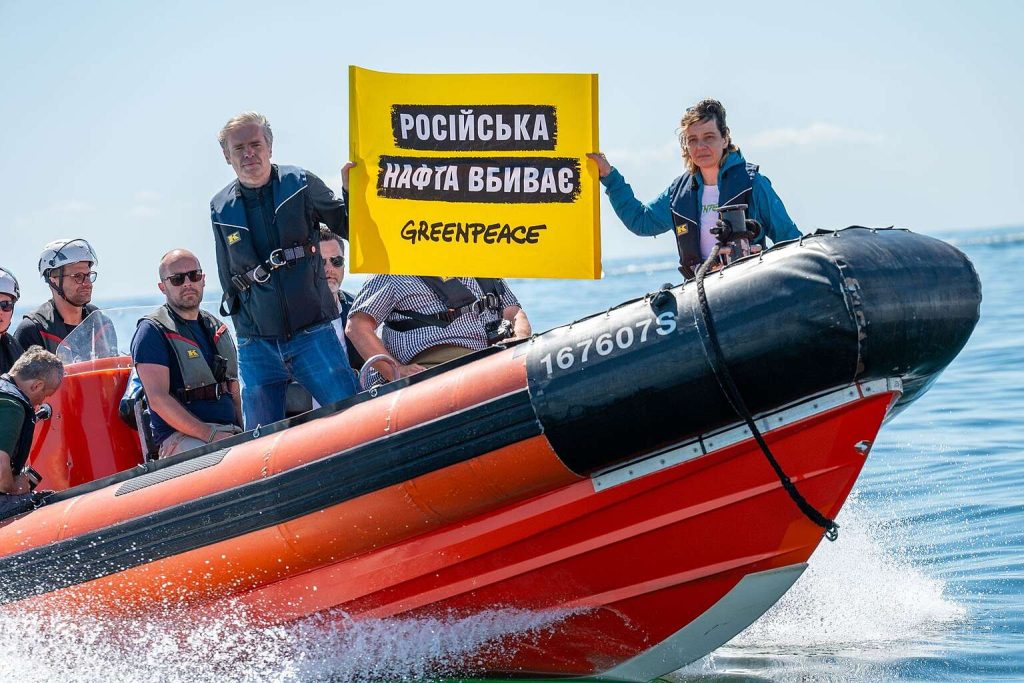
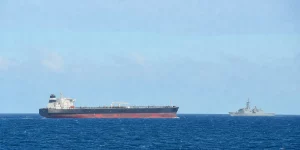
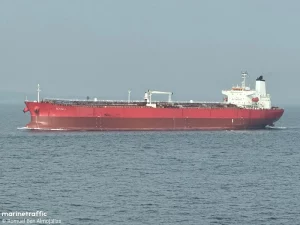
In early July, Greenpeace activists went to the Baltic Sea to document the “Kira K” tanker of the so-called “shadow fleet,” which is under sanctions. Soon, a Russian warship accompanying the tanker approached the activists and began to warn Greenpeace.
The campaign was attended by Natalia Gozak, the director of Greenpeace Ukraine, who documented the entire incident involving the Russian warship. USM spoke with the activist about what the “Kira K” incident shows, why the ship’s appearance near the tanker is an important signal for the countries of the Baltic region, and what environmental risks such shipments pose.
— Greenpeace Ukraine is usually perceived through environmental and energy topics. Is it true that the tracking of Russian maritime violators for the Ukrainian office of the organization began precisely in 2022?
Greenpeace International has indeed begun implementing projects in Ukraine since 2022, since the beginning of the full-scale invasion of Ukraine by the Russian Federation, but Greenpeace Ukraine as a separate organization appeared in 2024.
These projects focused on energy issues, energy transition and green recovery of Ukraine. This direction remains one of the key ones for Greenpeace’s work in Ukraine. Instead, the topic of the Russian shadow fleet is mainly implemented by other Greenpeace offices. In particular, Greenpeace Nordic, Greenpeace Germany, Greenpeace Poland and other network organizations are engaged in this.
As a representative of Greenpeace Ukraine, I have joined some of my colleagues’ events. But Greenpeace Ukraine is not currently conducting targeted work on the shadow fleet, we rather join the work of other offices.
In general, the Greenpeace Ukraine team is small – about ten people. These are mainly colleagues who deal with various energy or biodiversity issues in Ukraine, and I mainly deal with the shadow fleet industry myself.

Natalia Gozak, Director of Greenpeace Ukraine
— What did the situation with the Kira K tanker and the Russian warship look like to you from the inside? How dangerous was it to be at the scene of the events?
For me, it was a very impressive situation. Of course, we understood that such a possibility existed, but the initial idea of the action was to prove that the shadow fleet continues to move even despite the sanctions. The goal was also to attract the attention of the media, politicians and representatives of the parliaments of Germany and other countries in the Baltic region.
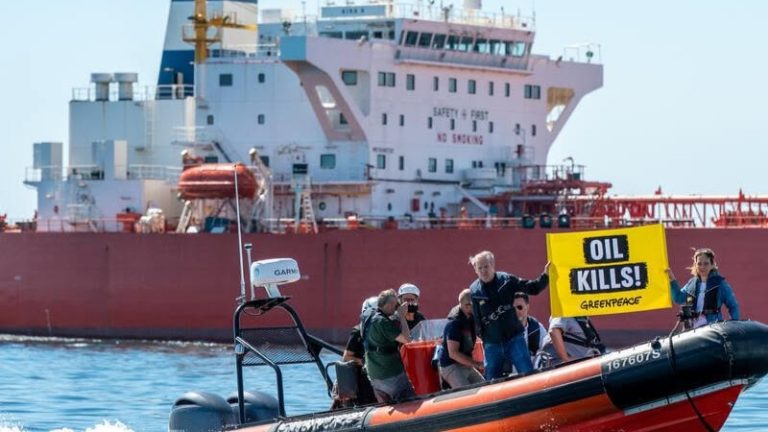
When we arrived at the site on inflatable boats, we met the “Kira K” tanker, which was moving along its route. It was an opportunity to see it, photograph it and record it.
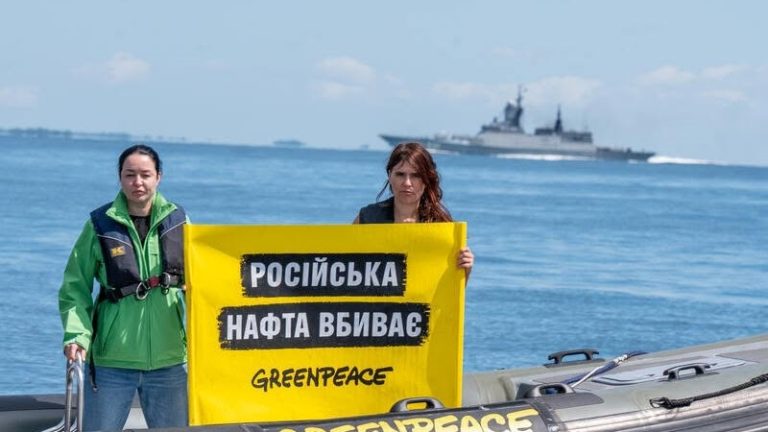
After that, a warship began to move towards us at high speed. Then there were negotiations on the radio between the ship, the tanker, the coast guard that accompanied us, and our boats.
For me, as a person living in Kyiv during almost five years of full-scale war, seeing this big gray warship was a very clear understanding that it was a threat. Five years ago, I might not have had such a feeling, I would have simply seen a warship. And now you understand very deeply that it may not be worth anything for them to sink these boats or take other actions that go beyond the normal logic of European navigation.
I think that my European colleagues did not have such a feeling. For them, it was outrageous, inappropriate that such a ship was there. But the feeling that this was a warship intended for destruction was probably the sharpest for me.
— Did the ship contact you directly or did the communication go through the coast guard?
He did not contact us directly. He transmitted through the coast guard that we should move away from the “Kira K” tanker. In this situation, it was clear what their purpose was there for. They actually announced that they were guarding the tanker. This was recorded on video.
Then the coast guard had a dialogue with them and asked what they were doing there. They replied that they were “moving according to a plan”. When they were asked what the plan was, the answer was: “a special plan”.
This dialogue was also recorded. For me, this is extremely outrageous, I have no idea how a military ship can move like this within the European region.
I am not a technical specialist, so I cannot say whether it was mandatory to turn on the transponder/AIS in this situation. It seems to me that it should be mandatory, although there may be some exceptions. But overall, the situation itself makes a very negative impression.
— What does this incident show in terms of the response of European countries to the shadow fleet?
Our colleagues from Greenpeace recently presented a report that confirms that European countries should not only impose sanctions on such tankers and ships of the shadow fleet, but also stop, monitor, inspect and, if necessary, arrest them.
Sweden has begun to take such actions in this region. And after Sweden began to act more actively in early March of this year, the tankers’ route changed. They began to move closer to Germany.
Now a larger number of such tankers are moving along the German coast. Obviously, they avoid situations where they can be stopped and monitored. Accordingly, if Germany also started to stop, monitor and arrest such ships, Russia would have to look for other ways to circumvent the sanctions.
In addition, this is complicated by the presence of Russian warships. I can understand why other countries are in no hurry to do this. At the same time, the answer here is in joint actions. European and Baltic countries should carry out such control exits not alone, but together. I am sure that if Ukraine is invited to participate, it will not refuse.
Now is the time for joint actions and time to stop this flow. This is Russian oil, which passes by the shores of European countries. It fills the budget of Russia to continue the war and at the same time creates an ecological threat.
— This year, Russian warships have been appearing more and more frequently near the shadow fleet. Does Greenpeace confirm this trend?
Yes, there are more and more such reports, and my colleagues from Greenpeace also confirm this trend. This year it has intensified even more, especially after March, when Sweden began to arrest tankers of the shadow fleet.
It was after this, according to our observations, that the topic of military presence near such vessels became more noticeable.
It seems that Russia is ready to protect its tankers with a military fleet. To me, this is a very clear signal of how important these oil flows remain for Russia. Russia lives off oil and gas exports. The income it receives from oil and gas exports every year is generally commensurate with the amounts it needs to wage war.
— Greenpeace has been talking about the environmental risks of the shadow fleet for many years. What are the greatest risks for the Baltic Sea?
The greatest risk is an oil or oil product spill. This is the main possible environmental impact of shadow fleet tankers.
This risk theoretically exists during any maritime oil transportation. But in the case of the shadow fleet, it is higher due to several factors. First, these vessels often operate without proper insurance, so the issue of liquidating the consequences of a potential accident becomes more complicated. Second, these are mostly outdated vessels. For example, the “Kira K” tanker is about twenty years old, and there are much older vessels. In general, the average age of such tankers is also close to twenty years.
A separate risk factor is ship-to-ship operations, i.e. the transshipment of oil from ship to ship directly at sea. This is a typical practice for the shadow fleet, and it is among the riskiest oil operations at sea.
All these factors together significantly increase the risk of spills. This is particularly dangerous for the Baltic Sea, as its ecosystems are vulnerable and are already under significant pressure due to intensive shipping and economic activity in the region. That is, another major risk is added to the existing load.
I am almost certain that if the intensive use of this route continues, sooner or later we will see a significant spill. Similar to what happened in December 2024 near the Kerch Strait.
— After incidents such as the Kira K situation, is the approach of foreign countries, organizations or businesses to the problem of the shadow fleet changing?
It is difficult to answer so far. First, only a few days have passed since the incident itself. At the same time, a lot of information about this case and the very fact of recording such a situation has appeared in the media.
I am sure that European countries and relevant government bodies have noticed this. This situation was definitely recorded at their level. But how much after this there will be an opportunity to implement specific actions depends on further decisions.
I do not think that we will see a quick result. It may be a matter of weeks or months. But I really hope that changes will occur and that control and restrictions on the passage of such vessels will be introduced. From now on, it does not depend on us. We will observe.
— To what extent is it realistic today to stop or significantly limit the movement of the shadow fleet using legal instruments?
If we talk about legislation, then the sanctions packages already contain a fairly large number of legal instruments adopted at the European level. Now the question is more about their application.
There is room for inspections, stops and arrests of such tankers already at the level of individual countries. This can be done by Poland, Germany, Denmark, Norway and other countries of the Baltic region, which have not yet taken such active actions. They obviously have the opportunity to do this now.
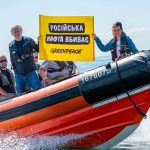
— Greenpeace often goes to sea on yellow inflatable boats. Why exactly such transport?
It is not a secret, but I probably do not have one exact answer. Most likely, it has developed historically. Inflatable boats, inflatables, are a very characteristic thing for Greenpeace.
At the same time, there is a whole team of activists who have all the necessary certificates to operate such boats. Everyone undergoes appropriate training.Greenpeace began its activities back in 1971, and for over 50 years, in one format or another, the use of inflatable boats has been part of the organization’s maritime work. Perhaps this is because they are easier to transport and haul. I also think there is a communication component here – the yellow boats with Greenpeace branding on the sides are already recognizable